

Fashion's Warning Label for Tech
Fashion's been doing this for 20 years. Tech, welcome to the chat: A New York Tech Week conversation on AI and the hidden cost of making it easier to build

Musings from a footwear designer (I’ve been to Beyonce’s house) turned tech founder (Alternew) on ownership and investing in the things we have.
Quick Fix (TLDR) ⚡
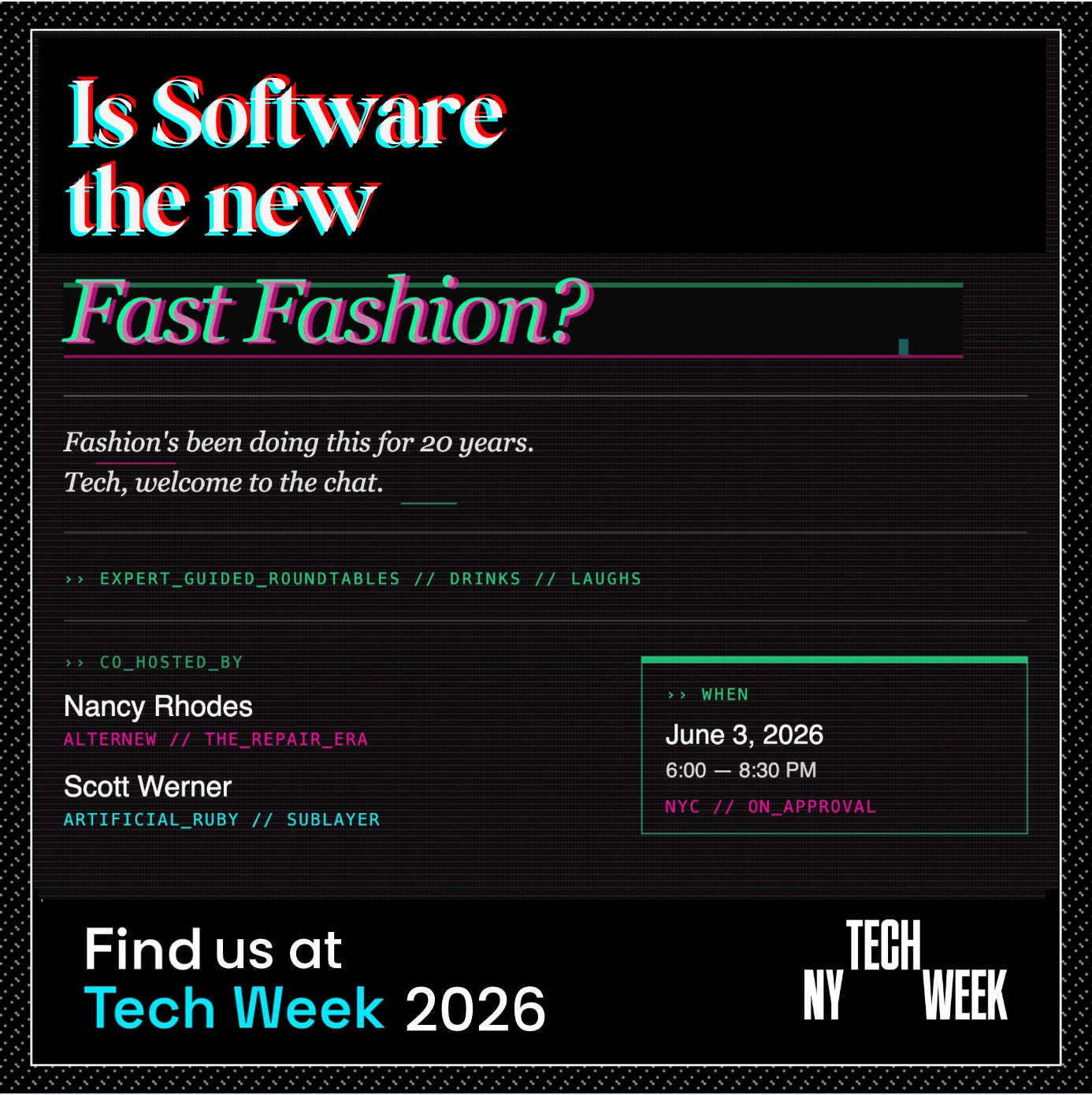
This Wednesday, I’m co-hosting “Is Software the New Fast Fashion?” as part of NY Tech Week with Scott Werner, founder of Artificial Ruby,Sublayer, Works on My Machine .
Fashion has spent the last twenty years learning what happens when speed becomes the strategy.
Tech is now entering its own version as AI makes it easier than ever to build, ship, rebuild, and move on.
We’re bringing founders, engineers, operators, investors, fashion leaders, and more into the same room for casual guided roundtables.
A few drinks. A few laughs. No panel.
Wednesday, June 3
6:00–8:30 PM
Custom Collaborative, NYC
RSVP: https://partiful.com/e/4iLm6df7Ix4OxkTWsJ5m
An engineer and a footwear designer turned tech founder walk into a bar (or an investor event)
Scott Werner and I have known each other for years.
We met through ERA, the accelerator both of our companies went through at different times. We were friendly, supportive, and mostly operating in parallel.
Scott builds in software and AI. (FYI chatGPT asked me to change my original description of engineer who builds technical techy things. I’ll let you decide which you prefer.)
I am a non-technical founder building tech in fashion, repair, and circularity.
A few months ago, we ran into each other at an ERA event and had one of those conversations where you leave and you’re like, “that was an awesome conversation!”
Scott was thinking about AI, software, and what happens when building gets easier. He talked about compound marketing and distribution.
I was thinking about fashion, ownership, and what happens when an industry gets too good at making things easier. I talked about supply chain and marketing teams.
Different industries. Different vocabulary. Different backgrounds. But I’ve been using Lovable and Claude and Chatgpt. He was using Substack and monthly events and community building and a new marketing toolkit.
And all of a sudden we were talking about the same things. it was fun to see commonalities in building and learning with the same reduced barriers to entry made it easier to have a conversation in a common vocabulary.
That conversation became the starting point for this event. He spoke at one of my events, then I spoke at one of his events, and now we’re putting some of our conversation into the tech week ether.
Fashion already ran the speed experiment
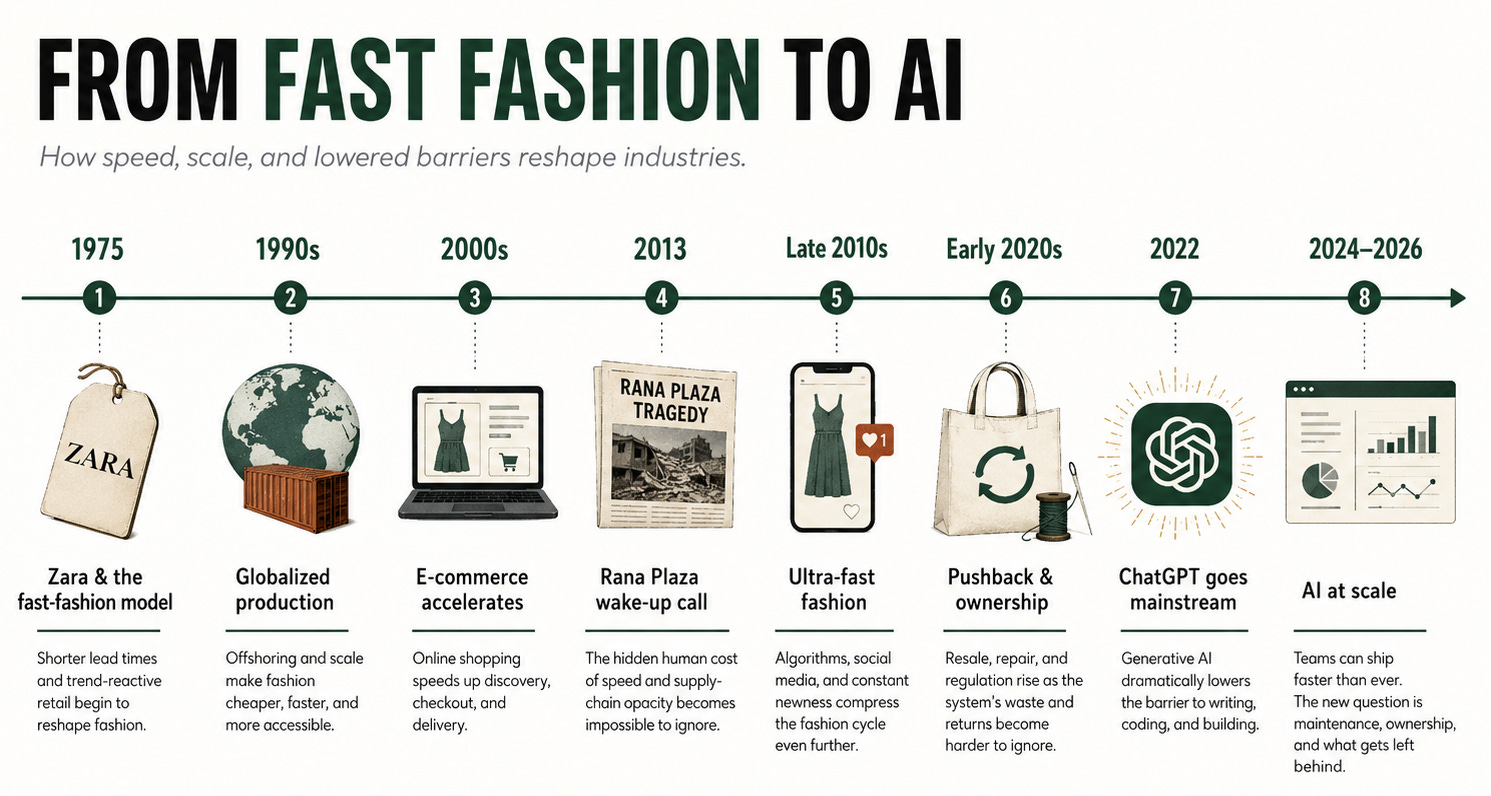
Fashion has spent decades making things cheaper, faster, and easier to replace.
For a while, that looked like growth.
Then it was returns. Waste. Overproduction. Quality issues. Broken customer trust. To name just a few.
Now AI is making it possible to build more quickly than ever. That is exciting. It also raises a question that the fashion industry didn’t think too much about when Zara became the great equalizer.
Before it was called fast fashion, it was democratization. Clothing is one of the first ways we are read by the world. When style became more affordable and accessible, it gave more people a way into rooms that may have otherwise judged them before they had a chance to speak.
But what happens after that part? How do we manage, regulate, support, keep standards, manage the aftermath of the growth flywheel.
Fashion does not have all the answers. Clearly.
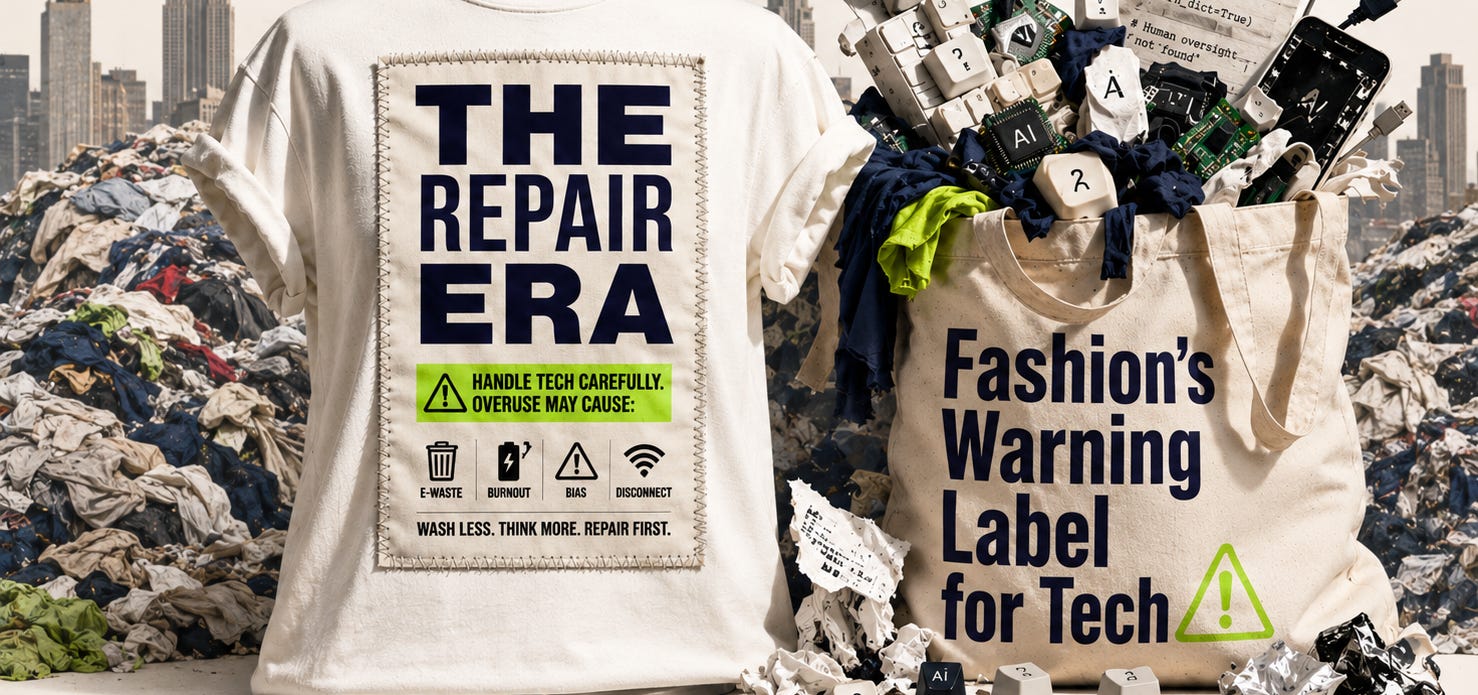
But it does have a warning label.
Speed can look like progress until the maintenance bill comes due.
What cross-industry actually looks like
I’ve spent years cultivating relationships across fashion. That’s what happens when you live in New York, you’re a shoe designer for a couple decades, and you get a Masters in your mid 30’s alongside career professionals in the same industry.
So I’ve got some people in my network who are always down for my quarterly roundtables and this is no different. But I’m kind of blown away by some of the people who have found this on their own!
We have fashion people joining from Bloomingdale’s, Kohl’s, Rent the Runway, Calvin Klein, and more.
And operators and builders from Google, Apple, Amazon, Bloomberg, Snapchat, TikTok, and beyond,
Plus investors, tech founders, and people who spend a lot of time researching retail and tech.
Obviously tech week draws attention, but I’m really proud of what we put together.
More on the venue: Custom Collaborative
We’re hosting at Custom Collaborative, a nonprofit and social enterprise that trains, mentors, and advocates for low-income, immigrant, and BIPOC women building fair-wage careers in sustainable fashion.
It is a beautiful, massive space near 35th and 8th, supported in part by grants from the NY Forward Initiative.
There will be sewing machines in the room, which I’m most excited about. And not because it’s a fashion event. Which it is. And isn’t.
But because it’s a facility that supports skill, labor, maintenance, and sustainable growth. And more engineers and investors should be in rooms with sewing machines.
Is Software the New Fast Fashion?
The comparison is not perfect. But it’s a great starting point.
But fashion has already lived through the promise and consequences of speed at scale. Tech is now facing its own version, accelerated by AI.
The point is to get people from different industries around the same table before the lessons become obvious in hindsight.
Less siloed.
More honest about what breaks, what lasts, and what we are responsible for maintaining.
Repair Notes
The more I build Alternew, the more I realize the work is not just selling a solution. It is helping people see the problem clearly enough to care.
Repair is still treated like an afterthought. Something that happens after the purchase, after the damage, after the return window, after the system has already failed. A cost center that is more expensive than buying new and distracts the customer from buying more.
I see it differently.
Repair is the throughline. It shows us what broke, what still has value, what people are trying to keep, and where the infrastructure is missing.
The fashion supply chain and AI are not technically the same industry (not talking about fashion tech semantics here), but both are dealing with what happens when speed gets easier than maintenance. Both are creating more, faster. Both are starting to ask what breaks, what lasts, if it matters, and who is responsible for the aftermath.
Sometimes the best way to explain the problem is to get people from very different worlds into the same room and let them realize they are asking versions of the same question.
If you’re in New York on Wednesday, come join us.
RSVP here: https://partiful.com/e/4iLm6df7Ix4OxkTWsJ5m
The Repair Era is a newsletter about repair culture, ownership economics, and the infrastructure gap in post-purchase fashion care. Written by Nancy Rhodes, founder of Alternew and the Ownership Intelligence Lab.